
JJ McCarthy: Who Is to Blame for His Struggles?

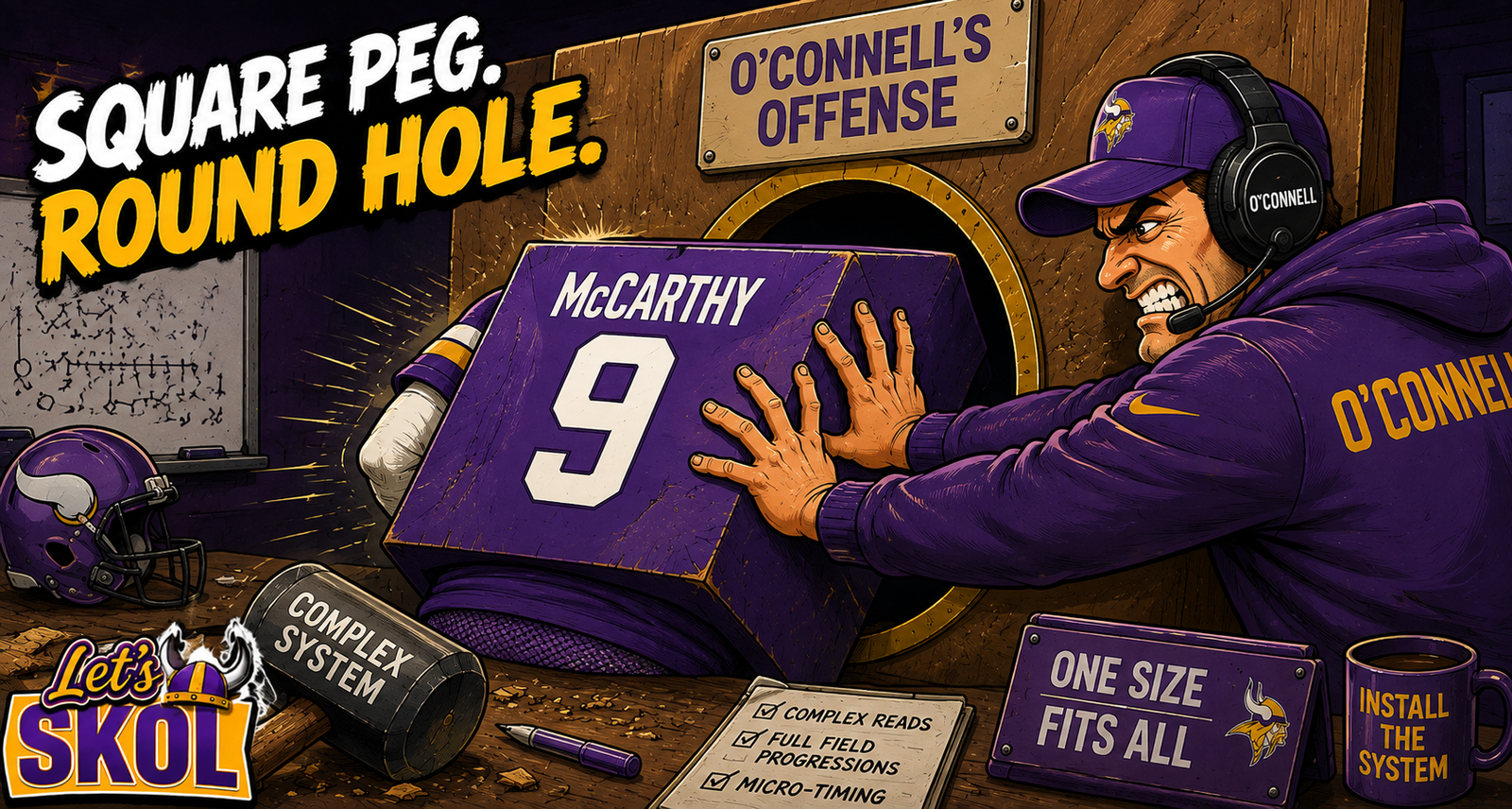
JJ McCarthy wasn’t just a quarterback the Vikings drafted in the top ten; he was a blueprint for how the franchise needed to build its future.
Instead of building a custom house for their new franchise quarterback, the Vikings’ front office and coaching staff tried to force him into an existing mansion with zero renovations. When you invest that level of draft capital into a signal-caller, the system has to bend to the player—not the other way around.
By treating the young passer like a plug-and-play veteran rather than a young talent who needed an offense tailored to his exact traits, the Vikings made their own path much harder than it ever needed to be.
McCarthy at Michigan vs. Minnesota
To understand why this experiment cratered, you have to look at what the young quarterback was asked to do during his time with the Michigan Wolverines.
Under Jim Harbaugh, he helmed a brutally effective, run-heavy juggernaut. He was a highly efficient point guard in an offense built on a punishing ground game, heavy play-action, and pre-snap motion designed to give him clear man/zone indicators.
Michigan insulated him, rarely forcing him to drop back 40 times a game and dissect complex coverages. He excelled at executing defined, first-read throws over the middle of the field while using his elite athletic traits to create outside of structure when things broke down.
Enter Kevin O’Connell and the Minnesota Vikings’ offensive system.
O’Connell’s playbook demands almost the exact opposite of what the former Wolverine did in college. It is a pass-heavy, true dropback system rooted in complex, full-field progressions. It requires a quarterback to stand firmly in the pocket, rapidly process defensive rotations, and deliver the ball with microsecond timing on deep, vertical concepts.
Where Michigan protected its quarterback with heavy personnel and max protection, O’Connell’s scheme forces the passer to act as the primary engine of the offense.
That massive leap—from a run-first infrastructure to a dropback-heavy system—exposed the starkest flaws in his game.
The On-Field Identity Crisis
The tape and analytical data from his rookie campaign tell a story of a young quarterback completely overwhelmed by a system that refused to meet him halfway.
He averaged a sluggish 3.04 seconds from snap to throw. That number doesn’t point to a lack of physical ability; it shows an elite athlete struggling to process what he’s seeing in real time.
Because the scheme didn’t offer him quick, defined reads, that hesitation translated into a brutal 27 sacks and dozens of unnecessary hits that took a physical toll on the rookie.
Furthermore, the young passer simply lacked the foundational mechanics required to consistently hit tight windows in this specific system.
Rather than adjusting the playbook to give him high-percentage completions, Minnesota leaned into a staggering 9.5-yard average depth of target (aDOT). Forcing a young quarterback to repeatedly execute deep, low-percentage dropbacks completely destroyed his efficiency.
The cascading effects of this scheme mismatch were devastating:
Erratic Efficiency: His completion percentage plummeted to a dismal 57.6%.
Turnover Troubles: He threw 12 interceptions against just 10 touchdowns.
Loss of Identity: In an attempt to mitigate the errors, coaches had to dumb down the playbook midseason, which ultimately compromised the entire identity of the Vikings’ offense.
Crucial Developmental Time Lost to Injury
Compounding this structural failure is the absolute lack of continuity the quarterback has faced from a physical standpoint.
A quarterback can only adjust to the speed of the NFL through live, unscripted reps, but his body simply hasn’t allowed him to stay on the field.
His developmental curve was fractured before it could even begin when he suffered a full right meniscus tear during his very first NFL preseason game in 2024. The subsequent surgical repair completely wiped out what should have been a foundational rookie season.
Instead of practicing O’Connell’s micro-timing offense on grass, he spent a year immobilized and rehabbing on a Microsoft Windows tablet.
He looked like a child glued to their tablet playing a digital game of tag rather than actually touching the grass and playing the real thing.
When he finally made his true debut the following year, the bad luck continued. A severe ankle sprain cost him another five games.
Out of 34 possible regular-season games across his first two years in the league, the former first-round pick has been healthy enough to play in just 10.
He has essentially had to spend his limited healthy moments correcting wonky mechanics on the fly while simultaneously fighting an offense that doesn’t fit him.
The Looming May 2027 Deadline
This lack of development has put the Minnesota front office in a historically fast financial vice.
Because the quarterback was a first-round selection, the Vikings face a massive franchise milestone in May 2027: the deadline to exercise or decline his fifth-year option.
Normally, teams use three full years of evaluation to determine if a young quarterback is worth a fully guaranteed, top-tier extension. But because of his extensive injury history, the Vikings are operating with an incredibly blank canvas.
They have a quarterback who has only played 10 real games, has shown major processing struggles, and is currently locked in a tense training camp quarterback competition with veteran Kyler Murray.
If he cannot stay healthy and completely transform his processing speed, the Vikings will be forced to make a multimillion-dollar decision in May 2027 essentially blind.
Declining the option admits a total draft bust. Exercising it risks tying up massive cap space in an unproven quarterback who was never a correct fit for the system in the first place.
The Two Paths to Quarterback Development
NFL history gives teams a clear choice when handling a highly drafted rookie: you either adapt your entire organization to his strengths, or you drop him into a foolproof infrastructure.
The Vikings completely misjudged which category their young passer fit into.
Path A: The Custom Build
Some quarterbacks possess such unique, dominant traits that standard NFL playbooks cannot contain them. Teams that recognized this completely rewrote their offensive philosophies to unlock their young passers.
We’ve seen this blueprint yield massive success with players like:
- Lamar Jackson
- Josh Allen
- Michael Vick
- Cam Newton
- Russell Wilson
These franchises didn’t ask their rookies to master a traditional dropback system on day one. They built custom rushing attacks, heavy play-action schemes, and moving pockets to maximize their playmakers.
Path B: The System Plug
On the other side of the coin are the rare, highly stable situations where a young quarterback enters a roster so loaded and a scheme so defined that he can simply play point guard.
Think of:
- Dak Prescott, stepping behind an elite Dallas offensive line with a dominant run game
- Ben Roethlisberger, backed by a legendary Pittsburgh defense and a bruising ground attack
- Brock Purdy, operating Kyle Shanahan’s highly structured, quarterback-friendly system
Minnesota operated under the delusion that the young passer could simply step into Kevin O’Connell’s offense and find the same immediate, plug-and-play success as a Purdy or Prescott.
The Cost of Rigidity
The Vikings forgot that JJ McCarthy belonged firmly in the first group—a young talent who required a tailored foundation to succeed.
By skipping the necessary structural renovations and handing a rookie an unedited, highly complex veteran playbook, Minnesota didn’t just stall an offense.
They broke their young quarterback’s developmental curve before it ever really had a chance to start.
Who Is to Blame?
When a top-ten pick goes off the rails like this, the inevitable question echoes through the fan base and front office:
Who is to blame?
Is it the quarterback’s fault for not developing into the player the Vikings wanted, or does the blame fall on an organization that completely mismanaged a premium asset?
The young passer absolutely has the raw talent to play quarterback in the NFL. We’ve seen the flashes.
It is incredibly unfair to blame a 21-year-old prospect for simply being who his tape always said he was.
He didn’t hide his playing style at Michigan. The Vikings knew exactly how insulated he was under Jim Harbaugh.
The blame must fall squarely on the organization.
Ironically, Kevin O’Connell himself has famously stated that “organizations fail young quarterbacks before young quarterbacks fail organizations.”
He once used a swimming analogy to slam impatient front offices, asking:
“In what world do you go from wearing a life vest and learning how to swim to being thrown in the deep end in the middle of a 200-meter freestyle against Michael Phelps?”
Yet, in a twist of supreme organizational hypocrisy, that is exactly what the Vikings did to their young quarterback.
The Vikings’ front office and coaching staff operated with a staggering level of arrogance. They assumed that their pre-existing infrastructure—headlined by elite pass-catchers and a quarterback-friendly coach—was so foolproof that they could drop any young quarterback into it and find success.
Instead of doing the hard structural work of adapting their system to shield his mechanical flaws and build on his play-action strengths, they expected the rookie to magically transform his entire football identity overnight.
They blamed the square peg for not fitting into their round hole when they were the ones who bought the peg in the first place.
Maybe, just maybe, the organization saw this failure—and the first head to roll was Kwesi Adofo-Mensah.
So what is next for the Vikings organization?
Does the quarterback finally bend to the will of the play-calling and develop the traits he was lacking, becoming the player the Vikings want to force him to be?
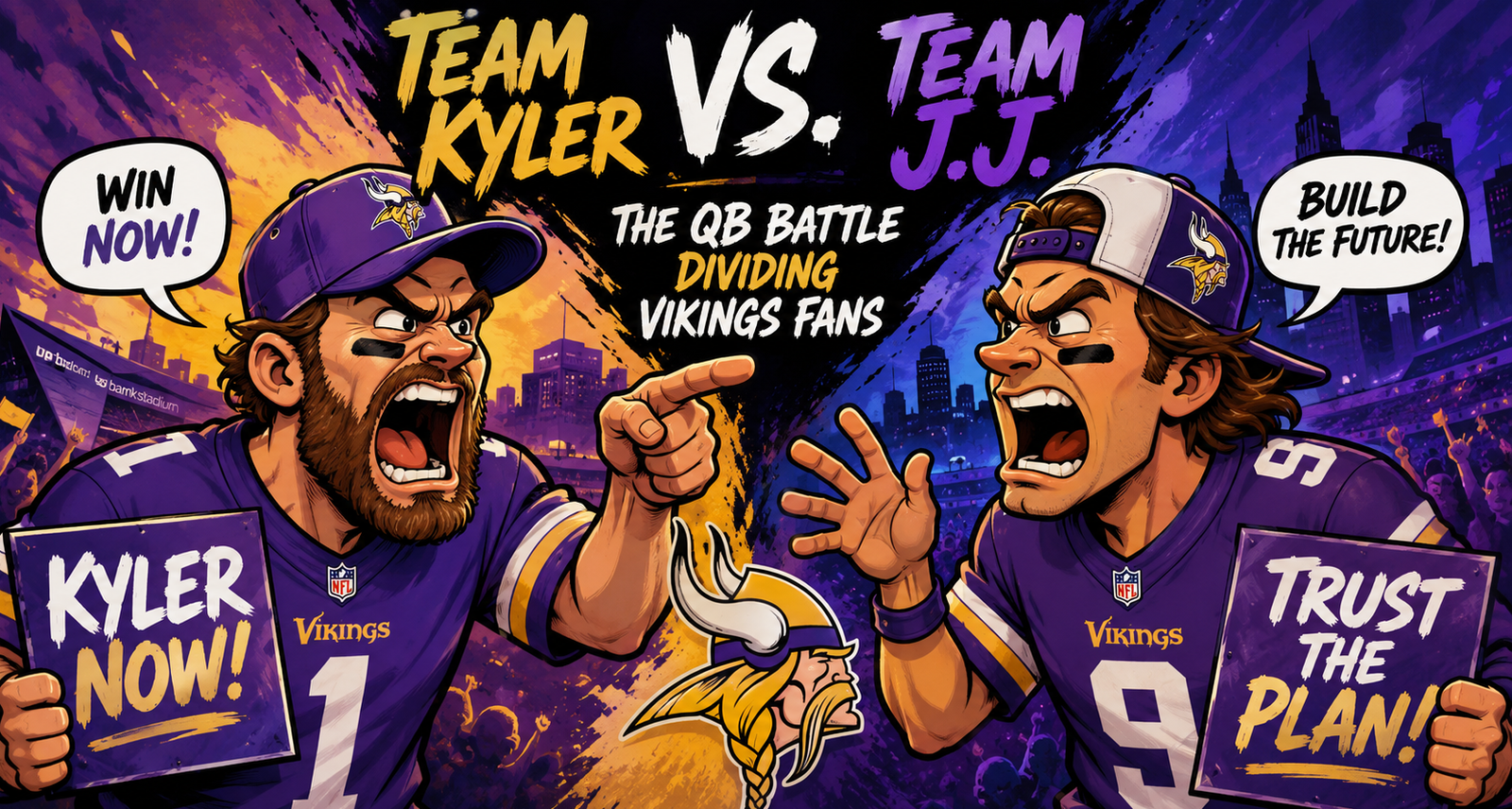
Or does Kyler Murray, another square peg, get forced through the same round hole?
Do the Minnesota Vikings look themselves in the mirror and do the hard thing—rebuild around a 2027 rookie quarterback the correct way—if both McCarthy and Murray fail?
There might be a lot of internal thinking within the organization during the 2026 season if it turns into a disaster.
And the man with the most important thoughts may be Nolan Teasley and what he decides to do come 2027.
If the season is a great success, well…
You can forget I even said anything.
Let’s SKOL!
Want to contribute to Let’s SKOL? Contact: LetsSkolShow@gmail.com
Great first article C Man . I wish everyone would have some old school patience and understanding. Everyone wants immediate success but they all forget the likes of Aikman at 1-15 , Manning 3-13, even Brees struggled early on. Minnesota can be the Michigan of the NFL. We’re blessed to have B-Flo. I personally hope we run the ball more to give our defense rest at times . Maybe KOC will not take Flo for granted . If we can run the ball more efficiently; more effectively that will benefit both Murray and or JJM . Regardless, I’m predicting 10-7 and the last wild card . SKOL Cody!