
Could Quenton Nelson Be the Missing Piece to the Vikings Offensive Line?

Could Quenton Nelson Be the Missing Piece to the Vikings Offensive Line?
The Minnesota Vikings are 5-0, but Donovan Jackson’s injury has created a problem up front. Could a blockbuster trade for Colts All-Pro Quenton Nelson provide both an immediate solution and a long-term upgrade? And could Minnesota actually afford to make it happen?
The Minnesota Vikings are 5-0. Five wins, zero losses, and heading into the bye week with every reason to feel good about where this team stands.
But being undefeated doesn’t mean everything is perfect. We’ve spent much of the first five weeks talking about an offense that hasn’t quite found its rhythm, a defense that’s been asked to carry a significant portion of the load, and an offensive line that’s already dealing with its share of adversity.
Unfortunately, that last problem became considerably worse when second-year offensive lineman Donovan Jackson suffered a torn meniscus against the Miami Dolphins. The injury required surgery and is expected to sideline him for the remainder of the regular season.
That’s a significant loss, especially for a team still trying to establish some consistency offensively. The obvious solution would be to find someone who can hold down the left guard position until Jackson returns.
But I keep coming back to a different question. What if the Vikings could turn an unfortunate injury into an opportunity to build an even better offensive line for the next several years?
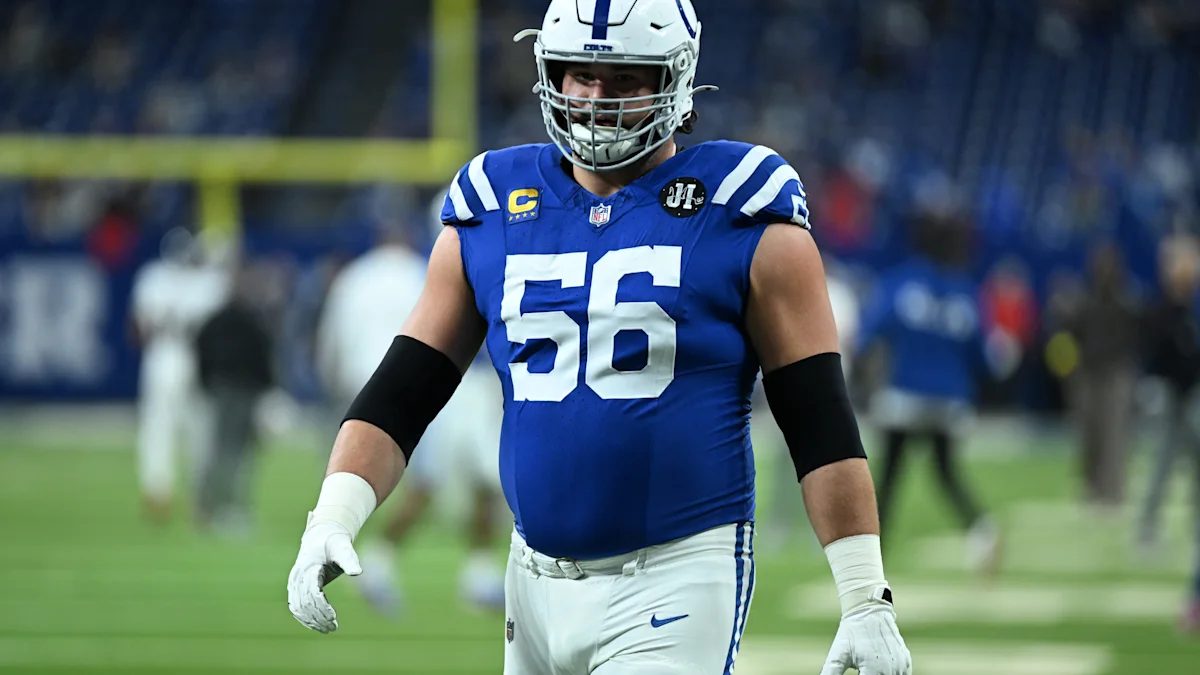
And that’s where Indianapolis Colts All-Pro guard Quenton Nelson enters the conversation.
Before anyone gets too excited, there’s no indication Indianapolis is actively shopping Nelson. This is purely a hypothetical trade I’d like to see Minnesota explore. But after digging into his contract situation, the Vikings’ offensive line, and the potential salary-cap implications, I think there’s at least an interesting argument for making the call.
Why Quenton Nelson?
Nelson doesn’t need much of an introduction. Since Indianapolis selected him sixth overall in the 2018 NFL Draft, he’s established himself as one of the best interior offensive linemen in football.
At 30 years old, his résumé includes eight Pro Bowl selections and six All-Pro honors, including Second-Team All-Pro recognition in 2025. And he hasn’t exactly been surviving on reputation.
According to the Pro Football Focus figures cited in the original research, Nelson finished fourth among qualifying guards in both overall grading and run blocking last season, earning grades of 84.5 and 84.3, respectively.
The Vikings have spent considerable resources trying to improve their offensive line in recent years. They didn’t sign Will Fries or use a first-round selection on Donovan Jackson because they were satisfied with the protection their quarterbacks had been getting.
Adding Nelson would represent another significant investment, but it would also give Minnesota something that’s difficult to find: a proven, high-level interior offensive lineman who can make an immediate difference.
He’s a physical run blocker, experienced in pass protection, and wouldn’t require Minnesota to experiment with moving players into unfamiliar positions to fill Jackson’s absence.
Of course, acquiring a player of Nelson’s caliber is one thing. Figuring out how to pay him is another.
What Would the Offensive Line Look Like in 2026?
For the remainder of this season, the fit is fairly straightforward. Assuming everyone else remains healthy, here’s what Minnesota’s offensive line could look like following a Nelson trade.
Proposed 2026 Starting Offensive Line
| Position | Player |
|---|---|
| LT | Christian Darrisaw |
| LG | Quenton Nelson |
| C | Blake Brandel |
| RG | Will Fries |
| RT | Brian O’Neill |
I like this arrangement for a couple of reasons. First, nobody else has to move. Nelson steps into his natural position at left guard, Fries remains at right guard, and the rest of the line stays together.
Second, it gives Kyler Murray an established veteran on the interior at a time when this offense desperately needs some stability.
We can debate how much of Minnesota’s offensive struggles have been caused by Murray, Kevin O’Connell, the play-calling, or the offensive line itself. My guess is there’s plenty of responsibility to go around. But regardless of where you assign the blame, improving the protection up front isn’t going to hurt.
It could also give O’Connell more confidence in the running game and, hopefully, allow the Vikings to find a better balance offensively.
And perhaps most importantly, Jackson wouldn’t have to rush his recovery to help a team with legitimate playoff aspirations. The Vikings could take their time getting him healthy while still fielding a formidable offensive line.
That’s the football argument. Now comes the complicated part.
Could the Vikings Actually Afford Quenton Nelson?
When we’re talking about adding a player of Nelson’s caliber, it’s easy to say the Vikings should make the move. Actually fitting him under the salary cap takes considerably more work.
According to the Over the Cap figures used for this proposal, Minnesota has approximately $6 million in available 2026 salary-cap space. Nelson carries a reported $24.2 million cap hit with Indianapolis this season.
At first glance, that probably makes the idea sound completely unrealistic. However, the Vikings wouldn’t necessarily inherit that entire $24.2 million.
Indianapolis would remain responsible for the applicable signing-bonus charges already allocated to its salary cap. Minnesota would take on the remaining transferable obligations in his contract.
Based on the salary information used in this hypothetical, a trade in mid-October could leave approximately $11.3 million in remaining 2026 salary obligations.
That’s still more than Minnesota’s available cap space, but it does create an opportunity to explore a contract extension.
Important: Those figures are working estimates. The exact amount Minnesota would inherit depends on Nelson’s contract language, the trade date, and the treatment of any guarantees or bonuses.
The Proposed Solution: A Three-Year Extension
Nelson is scheduled to become an unrestricted free agent following the 2026 season. And this is where I’d draw a pretty firm line.
I’m not interested in watching the Vikings trade valuable draft capital for an expensive 30-year-old guard who’s going to leave after a couple of months. If Minnesota makes this move, I want Nelson here beyond 2026.
My hypothetical proposal would be a three-year extension worth approximately $75 million, averaging $25 million per season and keeping him under contract through 2029.
That’s a significant investment, especially for a player who will be entering his 31-year-old season in 2027. But if the Vikings believe Nelson can continue playing at a high level, the extension could give them an opportunity to reduce his immediate cap charge by converting eligible salary into a signing bonus.
For example, if Minnesota could convert $9 million of his remaining 2026 compensation into a bonus and prorate that amount over four seasons, the immediate salary-cap savings could be substantial.
Under the original hypothetical model, Nelson’s 2026 Vikings cap hit could potentially fall to approximately $4.5 million.
I wouldn’t treat that figure as guaranteed. The final number would depend on which payments are actually convertible, the structure of the new agreement, and the applicable cap rules.
But the larger point is that Minnesota wouldn’t necessarily need to create room for Nelson’s entire remaining salary in 2026. The Vikings could also explore restructuring part of Brian O’Neill’s contract to create additional flexibility.
None of this makes Nelson cheaper. It simply changes when the money counts against the salary cap.
And as we’ve seen throughout the NFL, teams are more than willing to push money into future seasons when they believe the opportunity in front of them justifies it.
The question is whether Minnesota would consider Nelson that kind of opportunity.
What Would the Colts Want in Return?
This might actually be the more difficult part of the entire proposal. Nelson is still an important player for Indianapolis, and there’s no reason to assume the Colts would be eager to move him.
But they’re sitting at 2-3, and Nelson is approaching the end of his current contract. Would Indianapolis consider moving him if Minnesota offered draft capital rather than risk losing him in free agency?
I don’t know. But I’d certainly make the phone call.
The Vikings’ draft-capital situation is important here. According to the information in the original proposal, Minnesota owns two third-round selections in the 2027 NFL Draft, including an additional third-round pick acquired from Philadelphia in the Jonathan Greenard trade.
Assuming that pick remains available, here’s where I’d start.
My Hypothetical Trade Proposal
Minnesota Vikings receive:
- LG Quenton Nelson
Indianapolis Colts receive:
- 2027 third-round pick (Philadelphia)
- Conditional 2028 fourth-round pick
That’s my opening offer. Would Indianapolis accept it? Probably not without some serious discussion, considering Nelson’s accomplishments and the level he continues to play at.
The Colts might ask for a second-round pick instead, and that’s where this becomes a much tougher decision.
Ordinarily, I wouldn’t be particularly excited about surrendering a second-round selection for a 30-year-old guard who’s about to become a free agent. But the Vikings aren’t necessarily operating under ordinary circumstances.
They’re 5-0. They’ve already invested heavily in their offensive line, and there’s a legitimate argument that upgrading the interior could help unlock an offense that hasn’t consistently performed to expectations.
Would I consider giving up a second-round pick?
If Nelson agreed to an extension before the trade was finalized, I would. Would I be comfortable giving up significantly more than that? Probably not.
At some point, you have to balance the desire to win now with the reality that this team still needs affordable young players over the next several seasons.
And that brings me to what I find most interesting about this proposal.
Building the Vikings Offensive Line Beyond 2026
If the Vikings traded for Nelson, I wouldn’t necessarily view him as a replacement for Donovan Jackson. I’d view him as an opportunity to improve the entire offensive line.
Assuming Jackson makes a full recovery, Minnesota could explore moving him to right guard in 2027, with Nelson remaining at left guard.
Here’s the potential starting lineup.
Projected 2027 Offensive Line
| Position | Player |
|---|---|
| LT | Christian Darrisaw |
| LG | Quenton Nelson |
| C | Blake Brandel* |
| RG | Donovan Jackson |
| RT | Brian O’Neill |
Assumes Blake Brandel is re-signed.
Now, that’s an offensive line I’d be excited about.
You’d have Darrisaw and O’Neill at tackle, Nelson anchoring the left side of the interior, and a young first-round pick continuing his development at right guard.
There are some obvious questions about moving Jackson. He primarily played left guard and left tackle at Ohio State, so right guard wouldn’t be a position where he has established starting experience.
There would be an adjustment period. But I’d be considerably more comfortable exploring a move from left guard to right guard than asking him to become an NFL center without the same background at the position.
Of course, there’s another issue.
What happens to Will Fries?
Could the Vikings Move Will Fries in 2027?
Fries is currently under contract through the 2029 season. That’s why I wouldn’t automatically assume adding Nelson means the Vikings have to move Fries immediately.
In fact, keeping Fries at right guard for the remainder of 2026 is one of the biggest advantages of this proposal. But once Jackson returns, Minnesota would have some difficult decisions to make.
And trading Fries during the 2027 offseason is one possibility.
According to the original Over the Cap figures, Fries carries a scheduled 2027 cap hit of approximately $21.5 million.
If Minnesota moved him before an additional $10 million salary guarantee reportedly takes effect in March 2027, the team could potentially create around $9.5 million in salary-cap savings.
There would still be roughly $12 million in dead money, so this wouldn’t exactly be a clean financial escape. And there’s another detail that matters: the Vikings would need to find a team willing to take on Fries’ contract.
That’s easier said than done.
But if a trade partner existed, the savings could help offset Nelson’s projected 2027 cap hit. Using the hypothetical extension structure discussed earlier, Nelson’s 2027 cap number could be approximately $12 million.
That would mean Minnesota could potentially replace Fries with Nelson in its long-term plans while increasing its net 2027 cap commitments by roughly $2.5 million.
I find that possibility pretty intriguing. You’re not simply paying $25 million per year to add Nelson on top of everything else.
You’re restructuring the offensive line’s financial commitments, moving on from one veteran contract, and making room for Jackson to return to the starting lineup.
But I wouldn’t pretend this is a guaranteed solution.
It relies on several things working out, including finding a trade partner for Fries, Jackson successfully transitioning to right guard, and Minnesota being comfortable with the future cap consequences.

The Financial Risk Nobody Should Ignore
Here’s where I start getting a little nervous about the entire idea.
I love the thought of Quenton Nelson wearing purple. I love the idea of pairing him with Darrisaw on the left side. And I especially love the possibility of building an offensive line that gives the Vikings a legitimate advantage up front.
But $75 million is a lot of money. And pushing cap charges into future seasons doesn’t make them disappear.
Under the proposed structure, Nelson’s cap hit could potentially climb toward $33 million in 2028 and $37 million in 2029.
Those are enormous numbers for an interior offensive lineman. Minnesota could potentially restructure the contract again, but we’ve all seen what happens when teams continually push money into future years.
Eventually, the bill comes due.
Nelson would turn 31 during the 2027 offseason and 33 before the 2029 season. The Vikings would essentially be betting that a player who has already put together an outstanding career can continue performing at an elite level into his early 30s.
That’s certainly possible. But it’s not something I’d take for granted.
Injuries happen. Players decline. And contracts that look manageable when they’re signed can become major problems a few years later.
I’d also want to know what kind of guaranteed money Nelson would demand before deciding whether this trade really makes sense.
The average annual salary is important, but the guarantees and contract structure would tell us considerably more about Minnesota’s actual financial risk.
So while I believe there’s a path to making this work, I wouldn’t call it a slam dunk. Not even close.
Is Quenton Nelson Worth the Gamble?
The Vikings have spent years trying to get their offensive line right.
Christian Darrisaw and Brian O’Neill give them a foundation at tackle that plenty of teams around the league would love to have.
They invested significant money in Will Fries and used a first-round draft pick on Donovan Jackson. Those aren’t the moves of a franchise ignoring the offensive line.
But Jackson’s injury has created another obstacle at a time when the Vikings are trying to take advantage of a 5-0 start.
And as much as I appreciate what Brian Flores and this defense have done through five weeks, I’d feel a lot better about Minnesota’s championship chances if the offense could start holding up its end of the bargain.
I don’t think an offensive guard alone fixes everything we’ve seen from this offense.
Kyler Murray still has plenty to prove. Kevin O’Connell has to find ways to get the passing game going. The Vikings need to execute better, particularly when the defense isn’t putting them in favorable situations.
But improving the offensive line would certainly help.
And if Minnesota can acquire one of the best guards of his generation without completely sacrificing its future, I think it’s a conversation worth having.
What makes the idea appealing to me is that it doesn’t have to be about finding a temporary replacement for Jackson.
If the Vikings can work out a reasonable extension, eventually move Fries, and successfully transition Jackson to right guard, they could end up with an offensive line that’s even better than what they envisioned heading into 2026.
There’s plenty that would have to go right. Indianapolis would have to be willing to trade Nelson. The Vikings would have to agree to a significant contract extension. The salary-cap adjustments would have to work.
And Minnesota would have to be comfortable committing major money to a player who will be in his early 30s throughout much of the deal.
That’s a lot of moving parts.
But we’re talking about a team that’s undefeated through five games and has an opportunity to do something special this season.
I don’t want the Vikings making reckless decisions just because they’re 5-0. I also don’t want them being afraid to explore an aggressive move if it could make this team significantly better.
Would I trade a third-round pick for Quenton Nelson? Absolutely, assuming the extension makes sense.
Would I consider a second? Yes, although I’d need to feel pretty good about the contract before making that commitment.
The $75 million extension honestly makes me more nervous than the draft compensation.
But with the Vikings heading into their bye week undefeated and the trade deadline approaching, I’d like to believe the front office is at least exploring every reasonable opportunity to improve this roster.
What about you?
Would you give up a second-round pick and commit $75 million over three years to bring Quenton Nelson to Minnesota?
And would you be willing to move Will Fries next offseason to make Nelson part of the offensive line for the next several years?
Let’s hear it, Vikings fans. Let’s SKOL!
Want to contribute to Let’s SKOL? Contact: LetsSkolShow@gmail.com