
Establishing the Run: Kevin O’Connell Wants to Establish the Run—but Is It Happening?

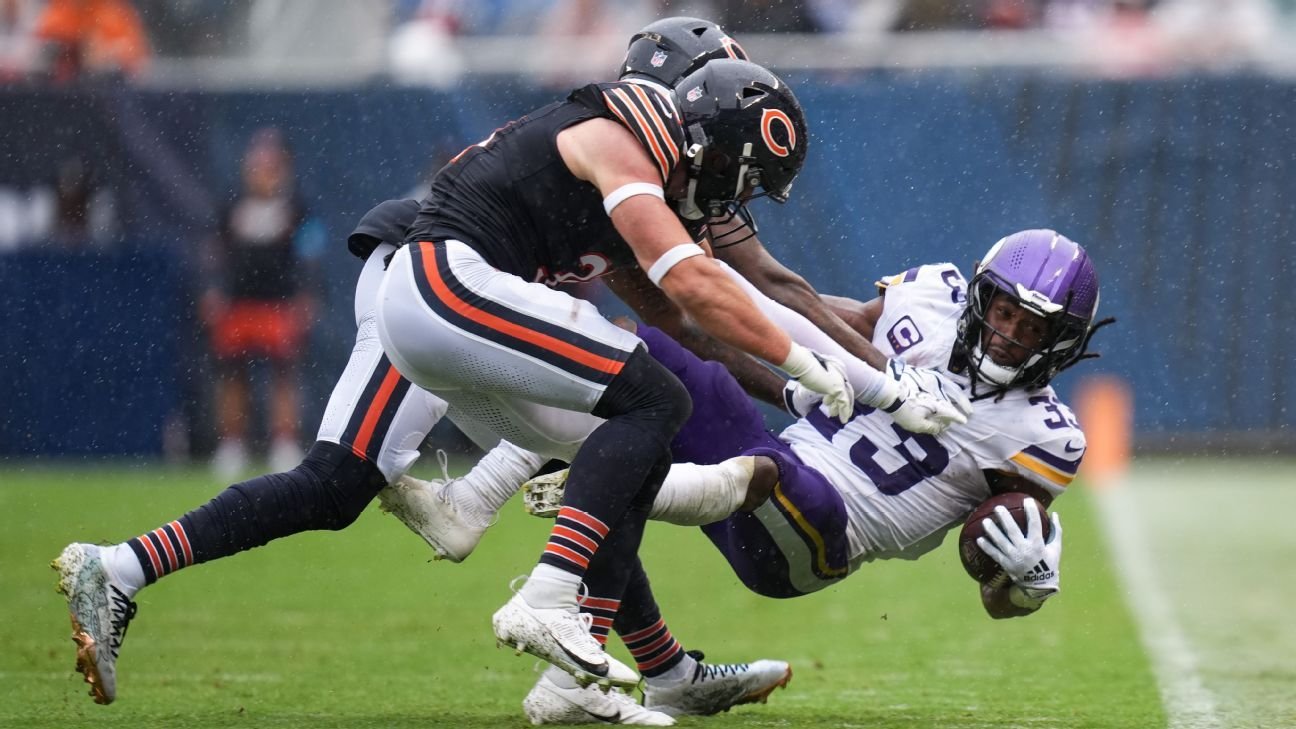
Minnesota Vikings head coach Kevin O’Connell has made his intentions clear: he wants to establish the run. It’s classic football, especially when you have a defense you can lean on. But intention and execution are two completely different things.
Establishing the run isn’t simply about handing the ball off repeatedly. It’s about gaining meaningful yards, particularly on early downs, setting up manageable third downs, keeping defenses guessing, and dictating the rhythm of the game.
Right now, the Vikings aren’t establishing the run. They’re forcing it.
Stats Can Be Deceiving
If you glance at the basic stat sheet, you might think things are fine. The Vikings rank 12th in the NFL in rushing yards.
But total yardage can create an illusion. Run the football enough times, and the yards will naturally accumulate. The real story is in the efficiency metrics, where Minnesota’s early-down struggles are putting the offense in difficult situations.
Through six games, the numbers paint an ugly picture:
- Early-Down Success Rate: 29% (Dead last in the NFL)
- Early-Down Plays Gaining a First Down: 18% (Dead last in the NFL)
- Early-Down Plays Gaining 7+ Yards: 24% (Dead last in the NFL)
- Plays Turning Into Third Downs: 62% (Most in the NFL)
These early-down numbers illustrate the bigger problem with Minnesota’s offense: far too many possessions are becoming an uphill battle before third down even arrives. And when a team is already struggling to move the football consistently, an ineffective running game only makes matters worse.
You’re not establishing dominance. You’re putting your quarterback in predictable, high-pressure situations and asking him to bail the offense out.
Nobody Fears the Running Backs
An effective running game needs to threaten defenses with more than a steady diet of two- and three-yard gains. Opposing coordinators need to believe that, if they make a mistake, your running back can make them pay.
Right now, Minnesota’s backfield isn’t giving defenses much reason to fear an explosive run.
To understand just how starved this offense has been for big plays on the ground, look at who has actually been generating its longest gains.
- 2026 Season: The most recent Viking to record a run of 35 or more yards was the quarterback, Kyler Murray.
- 2025 Season: Before Murray, the last player to accomplish that feat was wide receiver Jordan Addison on a gadget play.
- 2024 Season: You have to go all the way back to 2024 to find the last time a Vikings running back, Aaron Jones, broke off a run of 35 or more yards.
Let that sink in. Minnesota has gone through an entire season and much of another without a running back producing that kind of explosive play.
Diving deeper into this season’s numbers, the Vikings have recorded only three rushing plays of 15 or more yards and just one exceeding 25 yards. That’s not the kind of production that keeps defensive coordinators awake at night.
Instead, Minnesota has become a sluggish, predictable rushing team that relies heavily on grinding out short gains without consistently creating the explosive plays that can change a game.
Now, the running backs aren’t solely responsible. Run blocking, play design, and offensive predictability all contribute to the success or failure of a rushing attack. But regardless of where the blame belongs, the results aren’t good enough. And for a team with legitimate Super Bowl aspirations, that’s a problem.
What Is Run EPA?
To fully understand why Minnesota’s rushing struggles matter, we need to look at an advanced metric analysts use called EPA, or Expected Points Added.
Think of football like a board game where every spot on the field, down, and distance has a certain point value based on how likely a team is to score.
For example:
- Let’s say it’s first-and-10 at the opponent’s 20-yard line. Your expected points might be 3.5 because you’re already in scoring position.
- You hand the ball off and gain eight yards. Now it’s second-and-2, and your expected points might increase to 4.0. That play added 0.5 expected points to your possession. That’s positive EPA.
- But if the running back gets stuffed for a two-yard loss, it’s now second-and-12. Your expected points might drop to 2.8. That play cost your offense 0.7 expected points. That’s negative EPA.
Those numbers are illustrative, but the concept is straightforward. EPA measures how much a play improves or hurts a team’s expected scoring position.
Total rushing EPA combines the impact of a team’s rushing plays, while EPA per rush measures the average impact of each attempt. And right now, the Vikings’ rushing EPA is deep in negative territory.
Instead of consistently improving their chances of scoring, Minnesota’s ground game is too often putting the offense behind schedule.
That’s what makes the commitment to establishing the run so frustrating. Running the football is supposed to make life easier for the rest of the offense. For the Vikings, it’s too often doing the opposite.
What Does Adding a Star Running Back Do for the Passing Offense?
Unlocking Kyler Murray and the Passing Attack
The consequences of an inefficient ground game don’t stop with the running backs. They extend directly to quarterback Kyler Murray and the entire passing offense.
Kevin O’Connell brought Murray in to add a dynamic, multidimensional element to the offense. Instead, the lack of early-down efficiency has too often forced him into survival mode.
When the running game repeatedly fails to produce meaningful gains, it removes one of the quarterback’s most valuable advantages: the ability to keep defenses uncertain about what’s coming next.
A more productive ground attack could change that in two critical ways.
1. Erasing the Third-and-Long Nightmare
When Minnesota consistently finds itself in third-and-long situations, opposing defenses don’t have to guess nearly as much. They can anticipate the pass, attack with pressure, or drop additional defenders into coverage.
And the numbers show just how punishing those situations have been for Murray.
- The Third-and-Long Bottleneck: On third-and-7 or longer this season, Murray has completed just three passes that resulted in first downs on 25 passing attempts.
- The Conversion Struggles: His passing conversion rate in those situations ranks 33rd among NFL passers.
- The Mobility Factor: Murray has actually picked up more first downs with his legs (four) than with his arm (three) in those long-distance situations.
That’s a remarkable statistic for a quarterback brought in to help unlock an offense loaded with receiving talent.
Now, Murray isn’t completely blameless here. His own execution on early downs matters, too. But repeatedly asking your quarterback to convert third-and-long isn’t a sustainable offensive strategy, regardless of who’s under center.
Improving Minnesota’s early-down efficiency would help create more manageable third downs, giving Murray and O’Connell more options instead of forcing the offense into predictable passing situations.
Third-and-3 is a very different world from third-and-10. And right now, Minnesota is spending far too much time in the latter.
2. Revitalizing Play-Action and Creating Better Opportunities
Kevin O’Connell’s offensive system relies heavily on timing, progression-based passing concepts, and play-action to create opportunities for players like Justin Jefferson and T.J. Hockenson.
A productive running game can make those concepts even more dangerous. When defenses have to respect the possibility of a successful run, it can influence how linebackers and safeties react, opening opportunities in the passing game.
That doesn’t mean play-action only works when a team is running the football effectively. But having a legitimate rushing threat gives the defense another problem to account for.
And Minnesota desperately needs to create more problems for opposing defenses instead of continuously solving problems of its own.
Consider what we’ve already seen from Murray this season.
- The Potential: Against New Orleans, Murray completed an impressive 24 of 30 passes, demonstrating what he can do when the offense finds a rhythm.
- The Inconsistency: Despite those flashes, Murray ranks near the bottom of the league at 28th in passing EPA per attempt.
- The Pressure: Murray has already been sacked 12 times in his first five games, disrupting the timing and rhythm of the offense.
Some of those struggles belong to Murray. Some belong to the offensive line. And some belong to Kevin O’Connell and the system he’s trying to implement. But improving the running game could help all three. Instead of constantly asking Murray to escape pressure or manufacture something out of nothing, Minnesota could create more opportunities for him to operate within the structure of the offense.
Imagine a defense having to legitimately worry about a running back breaking off a 30-yard gain, Murray keeping the ball around the edge, or Justin Jefferson getting behind the secondary. That’s the kind of unpredictability this offense should be capable of creating. And it’s exactly what we’re not seeing consistently enough.

So What’s the Solution?
With Aaron Jones dealing with injuries and Minnesota struggling to generate explosive plays out of its backfield, the Vikings have a decision to make.
Can Kevin O’Connell fix this running game with the personnel already on the roster, or does Minnesota need to look outside the organization?
There’s certainly an argument that improved blocking, better play design, and a more creative approach could make a significant difference. But there’s also something to be said for adding a player who can create yards when the blocking isn’t perfect.
That’s what elite running backs do. They turn plays that should gain two yards into eight. They make the first defender miss. And occasionally, they turn an ordinary handoff into a game-changing touchdown.
Those are the plays Minnesota’s backfield has been missing.
A star running back isn’t going to magically fix every problem with the offense. But adding a legitimate difference-maker could provide exactly the spark this team needs.
And with the trade deadline approaching, Minnesota should be aggressively exploring that possibility.
The Time Is Now
Ultimately, this comes down to new general manager Nolan Teasley and what he’s willing to do to improve this roster.
The Vikings are 6-0, and Brian Flores has assembled a defense that has been nothing short of outstanding.
But how often does a team get an opportunity like this?
Minnesota has a defense capable of carrying this team deep into the postseason. The fanbase has been waiting decades for a Super Bowl championship, and the organization has an opportunity to capitalize on something special.
The last thing anybody wants is to watch this team finish with an outstanding regular-season record, only to see the offense sputter when the games matter most.
Kevin O’Connell has made it clear that he wants to establish the run. But wanting to establish it and actually doing so are two entirely different things. And simply handing the football off more often isn’t the answer.
The Vikings need an effective running game. One that produces meaningful yards on early downs, creates explosive plays, and gives Kyler Murray a legitimate complement in the backfield.
Maybe the answer comes from within. Maybe it requires a change in philosophy. Or maybe Nolan Teasley needs to make an aggressive move before the trade deadline.
But doing nothing and hoping the offense eventually figures itself out seems like an awfully dangerous gamble when you have a defense playing at this level.
The Vikings have a championship-caliber defense. It’s time to give that defense a championship-caliber offense.
Go get your running back. Give Kevin O’Connell another weapon, give Kyler Murray some help, and give Brian Flores and this fanbase a legitimate shot at the franchise’s first Super Bowl championship.
Let’s SKOL!
Want to contribute to Let’s SKOL? Contact: LetsSkolShow@gmail.com